Sierra Nevada de Santa Marta cacao and the TCS 01 clone: a maker's guide
TCS 01 is AGROSAVIA's flagship cacao clone: self-compatible, large-beaned and close to the Criollo type in its chemistry. Here is what it is, what the Sierra Nevada de Santa Marta is as a place to grow it, and how to judge a lot before you roast it.

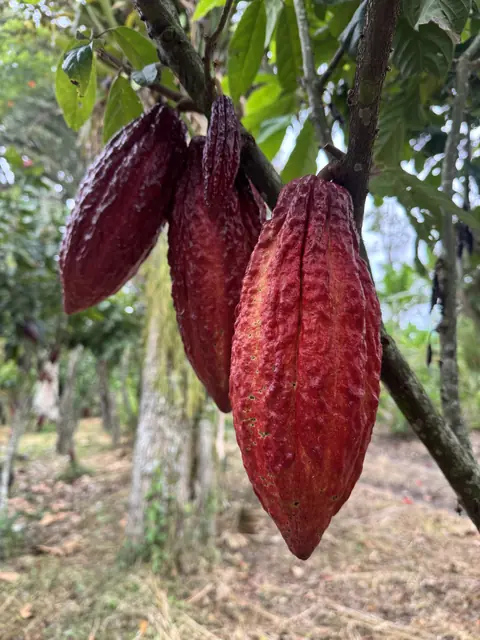
- TCS 01 is a clone from AGROSAVIA's La Suiza research center, registered with the ICA in 2014. It is self-compatible, has the largest beans of the TCS series and about 57% fat in AGROSAVIA's study.
- AGROSAVIA's panel describes citrus and yellow fruit, walnut, cocoa and a light floral note. Its chemistry sits at the boundary of the Criollo type.
- The Sierra Nevada de Santa Marta is an isolated massif on Colombia's Caribbean coast, separate from the Andes, and a UNESCO Biosphere Reserve since 1979. Its cacao grows on the lower slopes.
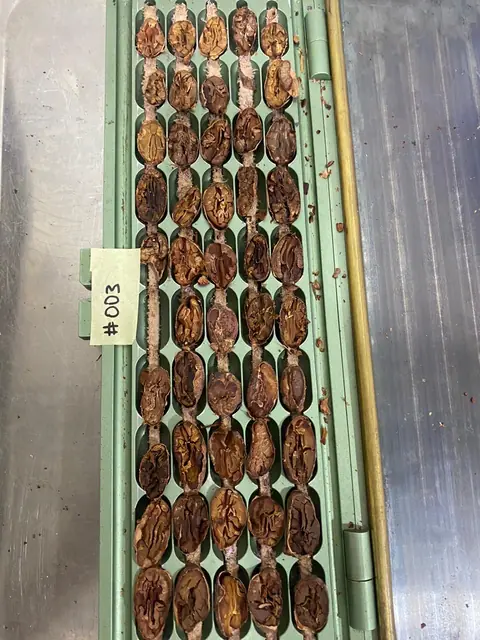
- Judge the lot, not the clone: cut test, bean count and moisture. Our Canaán pre-shipment sample measured 100% well fermented, 45 beans per 100 g and 7.3% moisture.
What TCS 01 is
TCS stands for Theobroma Corpoica La Suiza. Corpoica, renamed AGROSAVIA in 2018, is Colombia's agricultural research agency, and La Suiza is its main cacao research center, in Rionegro, Santander, at 550 m above sea level. From 2008, its researchers evaluated more than 255 genotypes in farmers' fields, working with the growers themselves, and coded the outstanding ones TCS.
TCS 01 was selected from material in Cóper, Boyacá. In 2014 it became, together with TCS 06, one of the first two AGROSAVIA varieties registered with the ICA, Colombia's agricultural regulator. You will see it written TCS 01, TCS-01 or TCS01; they are the same clone. Our guide to Colombian cacao varieties places it among the other TCS and Fedecacao clones.
TCS 01 at a glance
| Trait | TCS 01, per AGROSAVIA |
|---|---|
| Developer | AGROSAVIA (formerly Corpoica), La Suiza research center, Rionegro, Santander |
| Selected from | Material in Cóper, Boyacá |
| Registered | ICA, 2014 |
| Pollination | Self-compatible: sets fruit with its own pollen |
| Bean size | Largest of the TCS series |
| Fat | About 57%, the highest of the genotypes AGROSAVIA characterized (research samples) |
| Genetic type | Trinitario, at the boundary of the Criollo type by its theobromine-to-caffeine ratio; Criollo-type trait on young shoots |
| Sensory panel | Citrus and yellow fruit, walnut, cocoa, a hint of floral; medium bitterness, astringency and acidity |
| Developed for | Evaluated mainly under Santander conditions |
Why self-compatibility matters to a buyer
Many cacao clones cannot pollinate themselves. They are planted in mixed rows with a compatible donor, which is why most farm lots are blends. TCS 06, for example, needs TCS 01 or TCS 19 planted alongside it. TCS 01 can set fruit on its own, so a farm can plant it alone. That makes a single-clone lot possible, but it does not guarantee one: ask what else grows on the farm and whether it is kept out of the lot.
The Criollo question
AGROSAVIA classifies its genotypes partly by the ratio of theobromine to caffeine in the bean. TCS 06 and TCS 19 come out as Trinitario-type. TCS 01's ratio places it at the boundary of the Criollo type, and its young shoots show a Criollo-type trait. That describes its chemistry, not its pedigree. TCS 01 is a modern selection from Colombian farm material, and we describe it as a clone with Criollo-type traits, not as a Criollo.
The Sierra Nevada de Santa Marta as a cacao region
The Sierra Nevada de Santa Marta is a mountain massif that rises straight from the Caribbean coast of northern Colombia. It is independent of the Andes. UNESCO describes peaks of more than 5,700 m just 42 km from the sea.
It has been a UNESCO Biosphere Reserve since 1979, a reserve that also takes in Tayrona National Park on the coast. It is home to the Kogui, Arhuaco, Wiwa and Kankuamo peoples, whom Colombia's national parks agency describes as descendants of the Tairona civilization.
For cacao, what matters is the bottom of the mountain. Cacao generally grows below about 1,000 m, so Sierra Nevada cacao comes from the foothills and lower slopes. As in our guide to Colombian cacao regions, we will not give altitude, rainfall or temperature figures for the region as a whole: the research sources we rely on do not publish them. What we can give is one farm's own figures. Finca Canaán sits at about 90 m on the Caribbean side, where, per the farm, days reach about 33 °C and nights stay near 26 °C.
AGROSAVIA evaluated TCS 01 mainly under Santander conditions, at La Suiza's 550 m. A Sierra Nevada lot is the same genetics in a different place. How much place changes the bar is real but hard to isolate from fermentation and drying, so we make no claim for the region's flavor as a whole. Taste the lot.

What TCS 01 means at the roaster
Bean size
This is the clone's most practical trait. Canaán's pre-shipment sample measured 45 beans per 100 g, about 2.2 g per bean. For comparison, our Macondo lot, a blend of FSV 41 and FEAR 5, has a bean index of 1.8 g, roughly 55 beans per 100 g. Larger beans generally give a better ratio of nib to shell and roast more evenly, provided the lot is uniform, and the Canaán sample was rated high for size uniformity.
Do not assume a profile written for a smaller bean will carry over. Run a test roast, judge it by the nib, and roast it separately from smaller-bean origins rather than in a mixed batch.
Fat
About 57% fat is a striking number, but it was measured on research samples. It tells you how TCS 01 ranks against other clones in the same study, not what a commercial lot will test at. We have not published a fat figure for Canaán.
Flavor
AGROSAVIA's panel describes citrus and yellow fruit, walnut, cocoa and a hint of floral. The Fundación Carlota panel that tasted Canaán's liquor found overlap and differences: nut was its strongest note, at 5.5 out of 10, with cacao, light wood, citrus and orange blossom, and a finish of caramel, honey and fruit. Same clone, different farm and different fermentation. The overlap is roughly what genetics gives you; the rest is process and place, and no one can fully separate the two.
How to judge a TCS 01 lot
A clone name is a promise about potential. The lot tells you whether the farm kept it. These are the checks we would run on any TCS 01 lot, with Canaán's pre-shipment figures as an example:
| What to check | What to look for | Canaán pre-shipment sample |
|---|---|---|
| Fermentation (cut test) | Well-fermented beans far above the NTC 1252 premium minimum of 70 per 100 | 100% well fermented |
| Defects | Mould, slaty, insect-damaged and over-fermented at or near zero | 0% for each |
| Bean count | A low count (large beans), as TCS 01 should give, and even size | 45 beans per 100 g, about 2.2 g each; size uniformity high |
| Moisture | NTC 1252: 7.0% maximum for premium, 7.5% for the other grades | 7.3% internal (7.5% external) |
| Sensory | A panel on this lot's liquor, not a clone description | 8.5/10 overall, no defects |
| Clone | Which clones are in the lot | TCS-01 |
Read the moisture line honestly: 7.3% is inside the 7.5% limit of NTC 1252's standard grades and above the 7.0% of its premium column. The lot that lands will be tested again, and those reports go out with every sample.
Then check the numbers yourself. Our guide to the cacao cut test explains how to cut 100 beans, weigh them for your own bean count and compare the result with the supplier's report. A 1 kg sample is enough for several cut tests and a test roast.
A real example: Canaán
Canaán is our Sierra Nevada origin. Finca Canaán is in vereda Sierra Morena, Santa Marta, Magdalena, on the Caribbean side of the Sierra Nevada de Santa Marta. Viviana Gómez Sanmiguel and Luis Cala grow TCS-01 and raise their own seedlings in a nursery on the farm. Canaán is a member of COOAGRONEVADA, a cooperative of Sierra Nevada growers.
The farm took 1st place in the Concurso Nacional de Cacao "Grano de Oro" at the 12th Salón del Cacao y Chocolate de Colombia, in Arauquita, in October 2025.

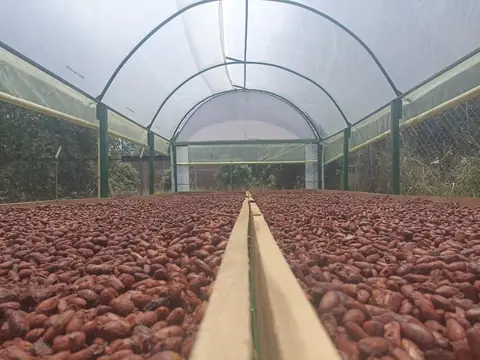
What sets the farm apart for a maker is its process records. Per the farm, beans ferment for about five days in wooden boxes of about 400 kg with drainage holes in the sides, with the first turn at 48 hours and then every 24 hours. They dry for about six days in a covered drying house: two hours of sun on the first day, four on the second, full sun from the third, covered at night. The temperature of the mass is logged at every turn, with air temperature and humidity, lot by lot.
The figures in this article come from Fundación Carlota's physical and sensory analyses of a 500 g pre-shipment sample in April 2026. They describe that sample, not yet the lot that lands. Canaán is arriving soon; no arrival date, quantity or price has been announced. The full spec sheet is on the Canaán origin page.
Frequently asked questions
What is TCS 01 cacao?
TCS 01 is a cacao clone developed by AGROSAVIA, Colombia's agricultural research agency, at its La Suiza research center in Rionegro, Santander, and registered with the ICA in 2014. It is self-compatible, has the largest beans of the TCS series and about 57% fat in AGROSAVIA's characterization, and its panel describes citrus and yellow fruit, walnut, cocoa and a light floral note.
Is TCS 01 a Criollo cacao?
Not in the strict sense. AGROSAVIA's theobromine-to-caffeine ratio places TCS 01 at the boundary of the Criollo type, and its young shoots carry a Criollo-type trait, but it is a modern selection from Colombian farm material. We describe it as a clone with Criollo-type traits, not as a Criollo.
Where is Sierra Nevada de Santa Marta cacao grown?
On the lower slopes of the Sierra Nevada de Santa Marta, the isolated massif that rises from Colombia's Caribbean coast in the departments of Magdalena, La Guajira and Cesar. Cacao generally grows below about 1,000 m, so it comes from the foothills, not the high mountain. Finca Canaán, for example, is at about 90 m on the Caribbean side, near Santa Marta.
How big are TCS 01 beans?
Large. AGROSAVIA's characterization puts TCS 01 at the top of the TCS series for bean size. On a real lot, check the measured bean count: Canaán's pre-shipment sample of TCS-01 measured 45 beans per 100 g, about 2.2 g per bean.
Can I buy Canaán TCS-01 cacao from SelvaCoa?
Canaán is arriving soon. No price or arrival date has been announced yet, but makers who roast from the bean can join the waitlist for a free 1 kg sample, which ships with the landed lot's lab reports.
- Báez Daza, E.Y. et al. (2022). Caracterización agronómica, fisicoquímica, sensorial y de metabolitos con actividad funcional de cacaos especiales cultivados bajo sistemas agroforestales en el departamento de Santander. AGROSAVIA. doi:10.21930/agrosavia.investigation.7405309
- Rodriguez-Medina, C. et al. (2019). Cacao breeding in Colombia, past, present and future. Breeding Science, 69(3), 373–382. doi:10.1270/jsbbs.19011
- Jaimes Suárez, Y.Y. et al. (2022). Modelo productivo para el cultivo de cacao (Theobroma cacao L.) en el departamento de Santander (2nd ed.). AGROSAVIA. doi:10.21930/agrosavia.model.7405538
- AGROSAVIA (2022). Clones de cacao de alta calidad – Centros de Investigación Nataima y La Suiza. agrosavia.co
- ICA, Instituto Colombiano Agropecuario. Registro Nacional de Cultivares Comerciales de cacao.
- NTC 1252 (2021). Cacao en grano: especificaciones y requisitos de calidad. ICONTEC.
- UNESCO Man and the Biosphere Programme. Sierra Nevada de Santa Marta Biosphere Reserve, Colombia. unesco.org/en/mab/sierra-nevada-de-santa-marta
- Parques Nacionales Naturales de Colombia. Sierra Nevada de Santa Marta National Natural Park. parquesnacionales.gov.co
- Fundación Carlota physical and sensory analyses, April 2026 (pre-shipment sample, provided to SelvaCoa).
- Finca Canaán, description of fermentation and drying process (May 2026, provided by the farm).
- Physical examination report No. 0250, Macondo lot (29 December 2025).