Colombian cacao varieties: a maker's guide to TCS, FSV, FEAR and Luker clones
Colombia's modern fine-flavor plantings are built on named clones: AGROSAVIA's TCS series, Fedecacao's regional selections such as FSV 41 and FEAR 5, and the private programs of the Compañía Nacional de Chocolates and Casa Luker. Here is what each one means for bean size and flavor.

- A cacao clone is a grafted copy of one selected tree. Colombia moved from seed-grown hybrids to clones to get predictable yield, disease tolerance and quality.
- Colombian clones come from four programs: AGROSAVIA (TCS), Fedecacao (FSV, FEAR, FEC, FLE, FSA, FTA), the Compañía Nacional de Chocolates (CNCH) and Casa Luker (Luker 40, Luker 50).
- For a maker, the useful numbers on a clone sheet are bean (seed) index, fat and the sensory panel, but they describe trial trees. Your lot depends on the clone mix and on fermentation.
- "Colombian" on a bag is not a variety. Ask which clones are in the lot and in what proportion.
What a cacao clone is, and why Colombia plants them
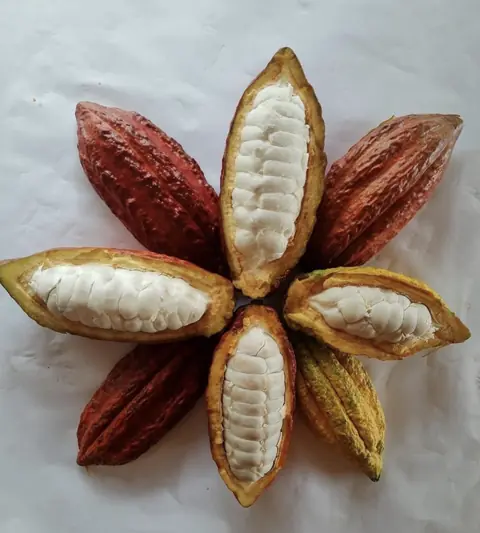
A clone is a variety propagated by grafting buds from one selected mother tree. Every grafted tree carries the same genetics. Trees grown from seed do not: cacao cross-pollinates, so each seedling is a new genetic combination.
Until around 2000, most Colombian farms were planted from seed. By the end of the nineteenth century the national crop had already become a Forastero–Trinitario hybrid population, and structurally it still is. Much of the planted area is old hybrid material, with yields well below what modern clones achieve.
Clones were the answer. From 1999, Corpoica (renamed AGROSAVIA in 2018) began selecting outstanding trees directly on farms with the growers, a method called participatory varietal selection. Fedecacao, the growers' federation, ran its own program in parallel. The best selections were then registered with the ICA, Colombia's agricultural regulator, in its national registry of commercial cultivars.
There is one consequence a buyer should understand. Many clones cannot pollinate themselves. They are planted in mixed rows with a compatible pollen donor, so a farm lot is usually a blend of two or more clones, not a single variety.
How to read a clone sheet as a chocolate maker
Clone descriptions are written for growers, so most of the numbers are agronomy: yield per tree, pod index (pods needed for one kilogram of dry beans), disease incidence. A few matter directly in the factory:
- Seed index (bean index). The average weight of one dry bean, in grams. It is the same figure you see on a cut-test report. Bean size affects roast evenness and the share of nib you recover after winnowing.
- Shell and kernel percentage. AGROSAVIA reports how much of each bean is shell. A thinner shell means more nib per kilogram bought.
- Fat content. Measured on research samples. It tells you how the clone compares with others in the same study, not what a commercial lot will test at.
- Genetic type. AGROSAVIA classifies its genotypes partly by the theobromine-to-caffeine ratio, which separates Criollo-like, Trinitario and Forastero-type material.
- Sensory panel. Trained panels taste unsweetened liquor and score cacao, fruity, floral, nutty and sweet notes against bitterness, astringency and acidity.
Treat all of it as potential. A clone sheet describes trees on a research station, fermented under controlled conditions. Post-harvest decides how much of that potential reaches your roaster. Our guide to reading a cut test covers how to check a real lot.
The TCS series: AGROSAVIA's clones
TCS stands for Theobroma Corpoica La Suiza, after AGROSAVIA's La Suiza research center in Rionegro, Santander, at 550 m above sea level. The selections came from farmers' fields across several departments and were evaluated at La Suiza. TCS 01 and TCS 06 were registered with the ICA in 2014; TCS 13 and TCS 19 followed in 2017. Other TCS numbers you may see are still under evaluation and are not registered.
TCS 01
The flagship. Selected from material in Cóper, Boyacá, it is self-compatible, so it can be planted on its own. It has the largest beans of the TCS series and the highest fat content of the genotypes AGROSAVIA characterized, about 57%. Its young shoots show a Criollo-type trait, and AGROSAVIA's chemistry places it at the boundary of the Criollo type. The panel describes fruity notes (citrus and yellow fruit), walnut and cocoa, with a hint of floral.
You can see it in our Canaán origin: TCS 01 grown in the Sierra Nevada de Santa Marta, measured at 45 beans per 100 g (about 2.2 g each) in its pre-shipment analysis, with nut, light wood and citrus on the tasting table. It is arriving soon, and you can join the free sample waitlist. For more on the clone and its region, read our guide to Sierra Nevada cacao and TCS 01.
TCS 06
Trinitario-type and self-incompatible: it needs TCS 01 or TCS 19 planted alongside as a pollen donor. Fat is around 55.5%. The liquor carries cocoa flavor from start to finish, with citrus fruit and a walnut and almond finish.
TCS 13
Registered in 2017, with fat around 55%. AGROSAVIA highlights it for the highest polyphenol content in the TCS group. Polyphenols contribute bitterness and astringency, so expect structure to manage in fermentation, roasting and conching. The panel describes cocoa and walnut notes with citrus, bittersweet and herbal accents. It sets more fruit when planted next to TCS 19.
TCS 19
Trinitario-type, self-compatible and compact, and the usual pollen partner for TCS 06 and TCS 13. Fat is around 55%. The panel finds a balanced liquor: cocoa first, with fruity, floral and walnut notes.
If a Colombian lot is described as "TCS", ask which numbers. A block of TCS 06 will almost always include its donor clone.
Before the TCS series, the same program's 1999 farm selections were coded SCC (Selección Colombia Corpoica). SCC 61, from San Vicente de Chucurí, is still found on Colombian farms.
Fedecacao's regional clones
Fedecacao selected trees on farms in Santander, Arauca and Antioquia. Eight clones were registered with the ICA in December 2014, and a ninth, FSV 155, in 2017. The names follow a pattern: F for Fedecacao, letters for the municipality where the mother tree was found, and a selection number.
- FSV 41 and FSV 155: Fedecacao San Vicente, from San Vicente de Chucurí, Santander. FSV 41 is self-compatible, and its beans are among the largest in the series, about 2 g.
- FLE 2 and FLE 3: Fedecacao Lebrija, Santander. FLE 2 also has beans of about 2 g.
- FEAR 5: Fedecacao Arauquita, Arauca. Covered in detail below.
- FSA 12 and FSA 13: Fedecacao Saravena, Arauca. FSA 13 has small beans, about 1.3 g.
- FTA 2: Fedecacao Tame, Arauca.
- FEC 2: Fedecacao El Carmen, noted for its tolerance to moniliasis, the fungal pod disease that is the most damaging cacao disease in Colombia.
FEAR 5, from the Arauca foothills
FEAR stands for Fedecacao Arauquita: the mother tree was selected in Arauquita, Arauca, in the Piedemonte Llanero, where the Eastern Cordillera drops to the plains. It was among the regional materials Fedecacao established in comparison trials in Arauca in the 1990s, and it was registered with the ICA in December 2014 (Resolution 4179) as one of the federation's first eight clones.
For a grower, FEAR 5 is self-compatible, so it sets fruit without a pollen partner. In Fedecacao's ten-year evaluation across 19 locations it averaged about 1,690 kg per hectare per year, among the highest of the clones tested, though it is rated moderately susceptible to moniliasis and needs good sanitary harvesting.
For a maker, the figure that matters is bean size: about 1.4–1.6 g per dry bean, depending on the study. That is medium, smaller than FSV 41. In Fedecacao's morphological characterization of its collection, FEAR 5 grouped close to TSH 565 in fruit, flower and bean traits.
It is also a clone one of Colombia's best-known chocolate companies works with closely: Casa Luker names FEAR 5 and Luker 40 as "some of our most worked and beloved cocoa clones."
Fedecacao has published much less sensory data for these clones than AGROSAVIA has for the TCS series, at least in the sources we rely on. Taste the lot rather than trusting a description.
Our own Macondo lot is a blend of exactly these two Fedecacao clones, FSV 41 and FEAR 5, both self-compatible. Its cut test measured a bean index of 1.8 g, between the two clones' published bean sizes. The full lot data is on the Macondo origin page.
CNCH 12 and CNCH 13
In 2021 the Compañía Nacional de Chocolates, part of Grupo Nutresa, registered two clones from its own research program. Both are self-compatible and recommended for 13 subregions, including Santander. Our sources publish little sensory data for them, so judge them by the lot.
Casa Luker's clones: Luker 40 and Luker 50
Casa Luker, the Colombian chocolate maker, runs its own cacao research farm, Granja Luker, in Palestina, Caldas, a marginal coffee zone, where it has spent five decades on research, training and producing planting material. Its clones Luker 40 and Luker 50 appear in AGROSAVIA's list of the improved materials Colombian farmers are planting, alongside the TCS, Fedecacao and CNCH clones.
Luker describes Luker 40, together with FEAR 5, as one of its most worked and beloved clones, and it turns up in Colombian research on fermentation, for example in starter-culture trials in Caquetá. What has not been published, at least in sources we could verify, is an official technical sheet with bean index, fat or a sensory panel. Nursery listings give figures, but they contradict each other, so we do not repeat them. If you see Luker 40 on a lot description, ask for the lot's own cut test and tasting notes.
Colombian farms also grow introduced clones bred abroad, often as rootstock under the grafted variety. Because the beans come from the variety grafted on top, the clones above are the names that matter on a lot description. For how genetics separates fine from ordinary cacao, see our article on fine-flavor versus bulk cacao.
The main registered clones at a glance
Bean sizes are shown only where the sources we checked agree. Where they disagree, we leave the cell blank rather than guess.
| Clone | Developer | Registered | Genetic type | Seed index | Sensory notes |
|---|---|---|---|---|---|
| TCS 01 | AGROSAVIA | ICA, 2014 | Trinitario, Criollo-type traits | Largest of TCS series | Citrus, yellow fruit, walnut, cocoa, light floral |
| TCS 06 | AGROSAVIA | ICA, 2014 | Trinitario | — | Cocoa, citrus, walnut, almond |
| TCS 13 | AGROSAVIA | ICA, 2017 | Sources disagree | — | Cocoa, walnut, citrus, herbal; high polyphenols |
| TCS 19 | AGROSAVIA | ICA, 2017 | Trinitario | — | Cocoa, fruity, floral, walnut |
| FSV 41 | Fedecacao | ICA, 2014 | — | About 2 g | Not published in our sources |
| FLE 2 | Fedecacao | ICA, 2014 | — | About 2 g | Not published in our sources |
| FEAR 5 | Fedecacao | ICA, 2014 | — | About 1.4–1.6 g | Not published in our sources; one of Casa Luker's most worked clones |
| FSA 13 | Fedecacao | ICA, 2014 | — | About 1.3 g | Not published in our sources |
| FEC 2, FLE 3, FSA 12, FTA 2 | Fedecacao | ICA, 2014 | — | — | Not published in our sources |
| FSV 155 | Fedecacao | ICA, 2017 | — | — | Not published in our sources |
| CNCH 12, CNCH 13 | Compañía Nacional de Chocolates | ICA, 2021 | — | — | Not published in our sources |
| Luker 40, Luker 50 | Casa Luker (Granja Luker, Caldas) | Private program | — | — | No official sheet published |
What this means when you buy Colombian beans
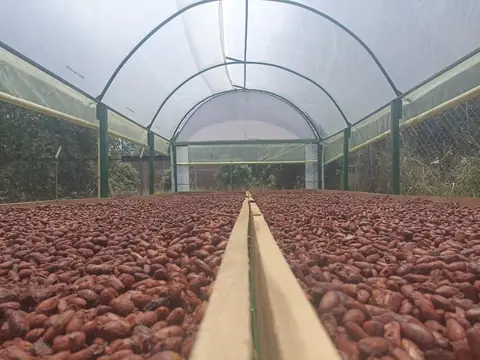
Genetics sets the ceiling. A TCS 01 or FSV 41 tree can only express flavor precursors it carries, and no fermentation turns bulk genetics into fine-flavor cacao. But genetics does not set the floor. Poor fermentation or rushed drying will flatten any clone, and fermentation is the step Colombian researchers single out as the most important for quality.
Four questions get you most of the way:
- Which clones are in the lot, and in what proportion? Expect a blend, because of pollination.
- Are any high-yield bulk clones planted on the farm, and are they kept out of this lot?
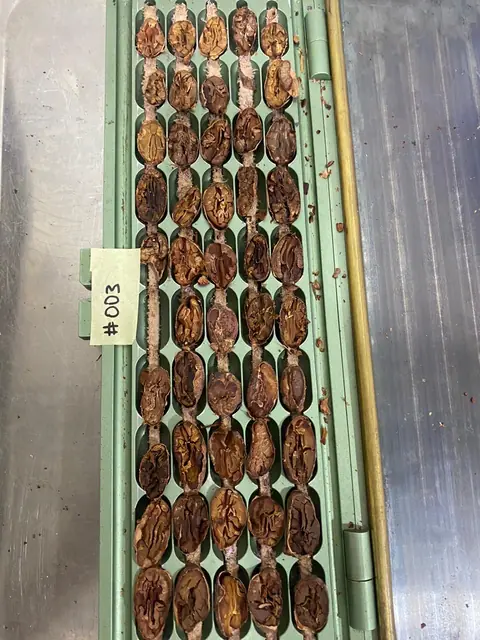
- What did the lot's cut test measure: fermentation, moisture and bean index?
- Is there a sensory evaluation of this lot, not of the clone in general?
Where the beans grow matters too, though less than people assume. Our guide to Colombian cacao regions covers Santander, the Llanos, the Pacific and the coffee region.
Frequently asked questions
What are the main Colombian cacao varieties?
Modern Colombian plantings are built on registered clones: AGROSAVIA's TCS series (TCS 01, 06, 13 and 19), Fedecacao's regional clones (FSV 41, FSV 155, FEAR 5, FEC 2, FLE 2, FLE 3, FSA 12, FSA 13 and FTA 2), the Compañía Nacional de Chocolates' CNCH 12 and CNCH 13, and Casa Luker's Luker 40 and Luker 50. Older farms also hold seed-grown hybrid trees that belong to no named clone.
What does TCS stand for in Colombian cacao?
TCS stands for Theobroma Corpoica La Suiza, after AGROSAVIA's La Suiza research center in Rionegro, Santander. Corpoica was renamed AGROSAVIA in 2018. TCS 01 and TCS 06 were registered with ICA in 2014, and TCS 13 and TCS 19 in 2017.
What is FEAR 5 cacao?
FEAR 5 (Fedecacao Arauquita 5) is a Fedecacao clone selected in Arauquita, Arauca, and registered with the ICA in 2014. It is self-compatible, with medium beans of about 1.4–1.6 g, and Casa Luker names it among its most worked clones. SelvaCoa's Macondo lot is a blend of FSV 41 and FEAR 5.
Which Colombian cacao clones have the largest beans?
In AGROSAVIA's characterization, TCS 01 has the largest beans of the TCS series. In Fedecacao's data, FSV 41 and FLE 2 are at the top of its series, at about 2 g per dry bean. Bean size on a real lot also depends on the clone mix and the season, so ask for the lot's measured bean index.
Which varieties are in SelvaCoa's Macondo beans?
The Macondo lot from Quimbaya, Quindío is a blend of two Fedecacao clones, FSV 41 and FEAR 5. The lot's cut test measured a bean index of 1.8 g.
- Rodriguez-Medina, C. et al. (2019). Cacao breeding in Colombia, past, present and future. Breeding Science, 69(3), 373–382. doi:10.1270/jsbbs.19011
- Báez Daza, E.Y. et al. (2022). Caracterización agronómica, fisicoquímica, sensorial y de metabolitos con actividad funcional de cacaos especiales cultivados bajo sistemas agroforestales en el departamento de Santander. AGROSAVIA. doi:10.21930/agrosavia.investigation.7405309
- Jaimes Suárez, Y.Y. et al. (2022). Modelo productivo para el cultivo de cacao (Theobroma cacao L.) en el departamento de Santander (2nd ed.). AGROSAVIA. doi:10.21930/agrosavia.model.7405538
- AGROSAVIA (2022). Clones de cacao de alta calidad – Centros de Investigación Nataima y La Suiza. agrosavia.co
- Fedecacao (2022). Ampliación del registro de materiales de Fedecacao para más regiones del país. fedecacao.com.co
- ICA, Instituto Colombiano Agropecuario. Registro Nacional de Cultivares Comerciales de cacao.
- Fedecacao. Mejoramiento genético de cacao en Colombia a través de selección varietal participativa (ICA resolutions 4179–4186, 2014; ten-year, 19-location evaluation).
- Fedecacao. Caracterización morfoagronómica y molecular de la colección de cacao de la Federación Nacional de Cacaoteros de Colombia.
- Fedecacao (2015). Guía técnica para el cultivo del cacao.
- Luker Chocolate. "Fine flavour cocoa, our quality promise." lukerchocolate.com
- "Granja Luker: el potencial está en los cacaos finos de aroma." Agronegocios (2018).
- Physical examination report No. 0250, Macondo lot (29 December 2025).