From harvest to chocolate: how a cacao bean becomes a bar
Chocolate is made from cacao beans in two halves: on the farm, ripe seeds are fermented and slowly dried; in the workshop, a maker roasts, winnows, grinds, conches and tempers them into a bar. Here is every step, in order.

- Chocolate is made in two halves: the farm turns fresh seeds into fermented, dried beans; the maker turns those beans into a bar.
- Fermentation creates the flavor precursors that roasting later develops. No roast can fix a bad ferment.
- Drying must be slow. Rushed drying seals the shell and traps acid inside the bean.
- At Finca Macondo, fermentation runs 5–6 days and drying 4–7 days, down to 6.8–7% moisture.
Every bar of bean-to-bar chocolate is the end of a long relay. Half of it happens on a farm, in a fermentation box and on a drying bed, weeks before a maker ever opens a box of beans. The other half happens in your workshop.
Both halves shape the flavor. Only one of them can be redone.
This guide walks the whole chain in order. For the farm steps we use the protocol documented at Finca Macondo, in Quimbaya, Quindío, the farm behind our Macondo origin. Those times and temperatures are Macondo's, not a universal recipe; other farms work differently. The workshop steps are described in general terms, because every maker's equipment and taste differ.
How is chocolate made from cacao beans? The short answer
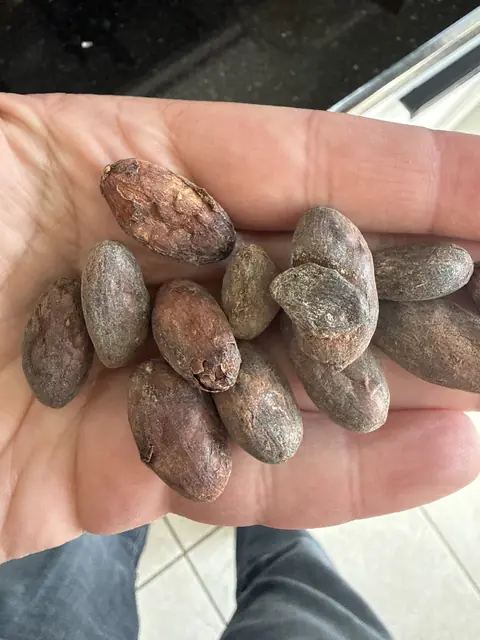
Ripe pods are harvested and opened. The wet seeds, still wrapped in sweet white pulp, are fermented for several days, then dried to around 7% moisture. The dry beans are sorted, graded and shipped.
A chocolate maker then sorts and roasts them, cracks them and blows away the shell, grinds the nibs into liquor, refines and conches the mass with sugar, tempers it and moulds it into bars.
That is the bean to bar process in brief. The rest of this article covers what changes at each step, and why it matters.
At the farm: from pod to dry bean
1. Harvest at ripeness
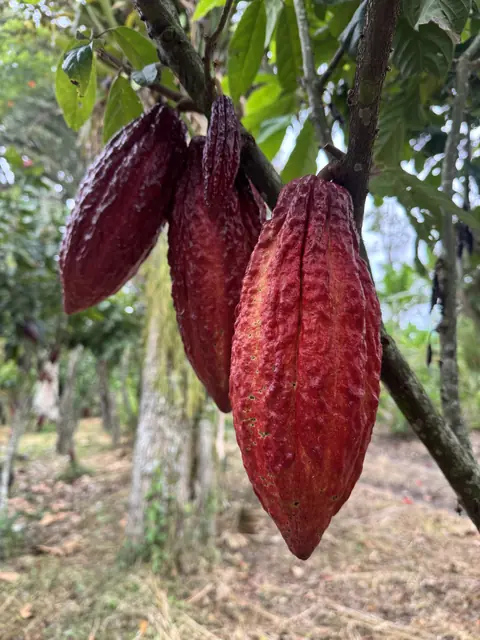
A cacao pod takes roughly five to six months to mature, and holds a few dozen seeds packed in a mucilaginous pulp. That pulp is the fuel for fermentation, so ripeness matters. An underripe pod brings less sugar to the box; an overripe one may hold seeds that have started to germinate.
Pods on a tree do not ripen together, so each is picked at its point. Macondo's protocol begins there.

2. Opening the pods
Pods are split and the seeds scooped out with their pulp. Fresh, they look nothing like chocolate: purple cotyledons inside a white, sweet coating. Husk fragments and the fibrous placenta that held the seeds are picked out so they do not go into the box.

3. Pre-drainage
Before the seeds go into the box, many farms let some of the pulp juice drain away. Too much pulp means too much sugar and liquid for the ferment to handle cleanly. Macondo pre-drains for up to 18 hours.
Macondo also checks two numbers at this stage: a Brix reading, which measures dissolved sugar, with a target of 14–15°, and a fresh-bean pH of 6.8–7.0. Those readings give the fermentation a known starting point instead of a guess.
4. Fermentation: two phases
Fermentation is the step that most separates fine-flavor cacao from bulk. The beans are piled into wooden boxes, covered, and left to heat up. Microbes do the work, in two broad phases.
Anaerobic phase. With little air in the mass, yeasts convert the pulp's sugars into alcohol, giving off heat. At Macondo this phase lasts 48 hours and the mass reaches 32–40 °C. The first turn comes at the 48-hour mark.
Aerobic phase. Turning lets air in. Acetic acid bacteria convert the alcohol into acetic acid, the temperature climbs, and acid soaks into the seed. Inside the cotyledon, proteins break down into peptides and amino acids, the precursors that roasting will later turn into chocolate aroma, and polyphenols oxidize, which softens bitterness and astringency. At Macondo the mass reaches 45–50 °C around day 4, with a strong acidic smell.
When to stop. There is no clock-based answer. Macondo ends fermentation on day 5 or 6, judged by smell and temperature. In AGROSAVIA's production model for Santander, box fermentation runs four to six days in total depending on genotype and climate, with the mass turned every 24 to 48 hours after the first two days.
Stop too early and the beans come out violet or slaty: bitter, astringent and flat. Go too long and off-flavors such as ham and rot appear. These are exactly the defects the cut test is built to catch.
5. Drying, slowly
Fresh from the box, beans hold about 55% moisture. They need to come down to roughly 6–7% to store and ship safely. Drying is also when part of the volatile acid from fermentation is meant to leave the bean.
Speed is the enemy. Dry too fast, in hard sun or with too much heat, and the shell case-hardens: the outside seals before the inside has given up its moisture and acid. The acid stays trapped, and the chocolate tastes sharp in a way no roast can fix. That is why AGROSAVIA recommends protecting beans from intense midday sun for the first two days of drying, then moving to full exposure.
Macondo dries over 4–7 days. Beans are turned every 30 minutes on the first day, every hour on the second, and every 90 minutes after that, until they reach 6.8–7% moisture. Frequent turning keeps drying even across the bed.
6. Sorting, grading and the cut test
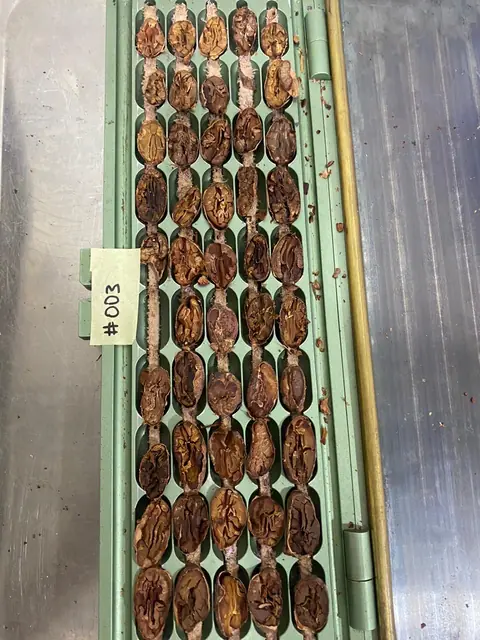
Dry beans are cleaned of stones, flat beans, broken pieces and clusters, then graded. The standard check is the cut test: a sample of beans is cut lengthwise and each bean is classified by its interior as fully fermented, partially fermented, violet, slaty, mouldy, insect-damaged or germinated.
The international standard ISO 2451 grades beans on those results, and Colombia's NTC 1252 does the same while also setting moisture limits.
For the Macondo lot harvested in October–November 2025, the cut test (report No. 0250, 29 December 2025) found 94% fully fermented, 2% partially fermented and 4% violet beans, with no mould, slate, insect damage or germination. Moisture was 7.1%, and the lot is Grade 1 under ISO 2451:2017. We explain how to read those numbers in the cut test, explained.
7. Bagging, storage and shipping
Dry cacao picks up moisture from humid air, and with it the risk of mould. It also absorbs odours. Hermetic liners, like the GrainPro bags our Macondo boxes are packed in, help hold the beans at their dried moisture through storage and transport.
The whole chain at a glance
Farm-side times below are Macondo's documented protocol. Workshop times are deliberately general.
| Step | Where | Time | What changes |
|---|---|---|---|
| Harvest | Farm | Pods mature in about 5–6 months | Pulp is sugar-rich and ready to ferment |
| Pod opening | Farm | Varies by farm | Seeds and pulp separated from husk and placenta |
| Pre-drainage | Farm | Up to 18 h | Excess pulp juice drains; Brix 14–15°, pH 6.8–7.0 |
| Anaerobic fermentation | Farm, wooden box | First 48 h | Yeasts turn sugar into alcohol; 32–40 °C |
| Aerobic fermentation | Farm, wooden box | To day 5–6 | Acetic acid enters the seed; 45–50 °C around day 4; flavor precursors form |
| Drying | Farm | 4–7 days | From about 55% to 6.8–7% moisture; volatile acid leaves |
| Sorting and cut test | Farm and lab | Before export | Defects removed; lot graded |
| Storage and shipping | Hermetic bag, warehouse | Varies | Moisture held steady |
| Sorting | Workshop | Varies | Flats, clusters and foreign matter removed |
| Roasting | Workshop | Tens of minutes, by profile | Maillard aromas develop; shell loosens |
| Cracking and winnowing | Workshop | Varies | Shell separated from nib |
| Grinding and melanging | Workshop | Hours | Nibs become liquid cacao mass |
| Refining and conching | Workshop | Many hours to days | Particles shrink; acidity mellows; flavor rounds |
| Tempering | Workshop | Varies | Cocoa butter set in its stable crystal form |
| Moulding | Workshop | Varies | Bars set with snap and gloss |
At the maker's bench: from bean to bar
Everything above happened before you opened the box. From here on, the decisions are yours.
Sorting
Even a clean lot is worth a pass by hand. Flat beans, clusters and the occasional stone come out before they can spoil a batch or damage a grinder.
Roasting
Roasting develops what fermentation set up. The amino acids and sugars produced in the box react under heat, the Maillard reactions, to build chocolate, nut and caramel aromas, while moisture and some volatile acid leave the bean and the shell loosens. A gentle roast keeps fruit and acidity; a heavier one pushes toward cocoa and roast notes.
Profiles vary widely with roaster, batch size and bean size, so test in small batches. For Macondo we share one tested profile, from Edwin Calderón of Cacao Trueques, as a second opinion to compare against rather than a recipe. One of its notes: the bright citric character is varietal, so don't roast it out.
Cracking and winnowing
Roasted beans are cracked into pieces, and a stream of air carries off the lighter shell, leaving nibs. Shell left in the nib adds grit and off-flavors, so winnowing shows up directly in the bar. As one data point, a test roast of Macondo recorded 3.4% roast loss, 21.4% shelling loss and a 75% nib yield.
Grinding and melanging
Nibs are ground until the cocoa butter inside them is released and the mass turns liquid. Many small makers do this in a stone melanger, which grinds, refines and conches in one machine. Sugar goes in here, along with milk powder for milk chocolate and extra cocoa butter if the recipe calls for it.
Refining and conching
Refining reduces particle size until the chocolate feels smooth rather than gritty on the tongue. Conching is long, warm mixing that drives off remaining volatile acids, coats the particles in fat and rounds the flavor.
In a melanger the two overlap, and run time is one of the strongest levers a maker has over texture and acidity. The Macondo profile mentioned above plans for 20 hours or more of grinding and conching.
Tempering
Cocoa butter can crystallize in several forms, and only one of them gives a bar a clean snap, a glossy surface and resistance to bloom. Tempering is the controlled cooling, working and gentle rewarming that favors that stable form, whether on a marble slab, with seed chocolate or in a tempering machine.
Moulding
Tempered chocolate is poured into moulds, tapped to release air and cooled. Well-tempered chocolate contracts slightly as it sets and releases cleanly from the mould. Then it is wrapped, labelled with its origin, and the relay is complete.
What this means when you buy beans
Most of a bar's flavor potential is fixed on the farm. Roasting and conching can shape what a well-fermented bean offers. They cannot create precursors that fermentation never made, or remove acid that rushed drying locked in.
That is why the most useful questions to ask a supplier are about the farm half: how long was it fermented, how was it dried, and what does the cut test say. For a structured way to ask, see our checklist for choosing a cacao bean supplier. For how a tree's genetics feed into all of this, read Colombian cacao varieties and clones.
Frequently asked questions
How long does it take to turn cacao beans into chocolate?
On the farm, fermentation and drying together take one to two weeks. At Finca Macondo, fermentation ends on day 5 or 6 and drying takes 4 to 7 days. In the workshop, roasting through moulding usually takes a few days, with grinding and conching the longest step.
Why do cacao beans need to be fermented?
Fermentation creates the flavor precursors, mainly peptides and amino acids, that roasting later turns into chocolate aroma, and it softens bitterness and astringency. Unfermented beans make flat, bitter, astringent chocolate no matter how they are roasted.
What is the difference between the anaerobic and aerobic phases of cacao fermentation?
In the anaerobic phase, yeasts in the airless bean mass turn pulp sugar into alcohol. Turning the beans lets air in and starts the aerobic phase, when acetic acid bacteria turn that alcohol into acetic acid, the temperature rises, and acid enters the seed to trigger flavor-forming reactions. At Macondo the first phase lasts 48 hours at 32–40 °C, and the second reaches 45–50 °C around day 4.
What moisture should dried cacao beans have?
Around 7%. Colombia's NTC 1252 sets a maximum of 7.0% for its premium grade and 7.5% for its standard grades. Wetter beans risk mould in storage. Macondo's protocol dries beans to 6.8–7%.
- Jaimes Suárez, Y.Y. et al. (2022). Modelo productivo para el cultivo de cacao (Theobroma cacao L.) en el departamento de Santander (2a ed.). AGROSAVIA. doi:10.21930/agrosavia.model.7405538
- Báez Daza, E.Y. et al. (2022). Caracterización agronómica, fisicoquímica, sensorial y de metabolitos con actividad funcional de cacaos especiales cultivados bajo sistemas agroforestales en el departamento de Santander. AGROSAVIA. doi:10.21930/agrosavia.investigation.7405309
- ICONTEC (2021). NTC 1252, Cacao en grano: Especificaciones y requisitos de calidad.
- ISO 2451:2017, Cocoa beans: Specification and quality requirements. International Organization for Standardization.
- Finca Macondo post-harvest protocol, and Physical examination report No. 0250 (29 December 2025, analyst Edwin Calderón Agudelo), Macondo lot, harvest October–November 2025.
- Test roast and roasting profile for the Macondo lot, Edwin Calderón, Cacao Trueques.